

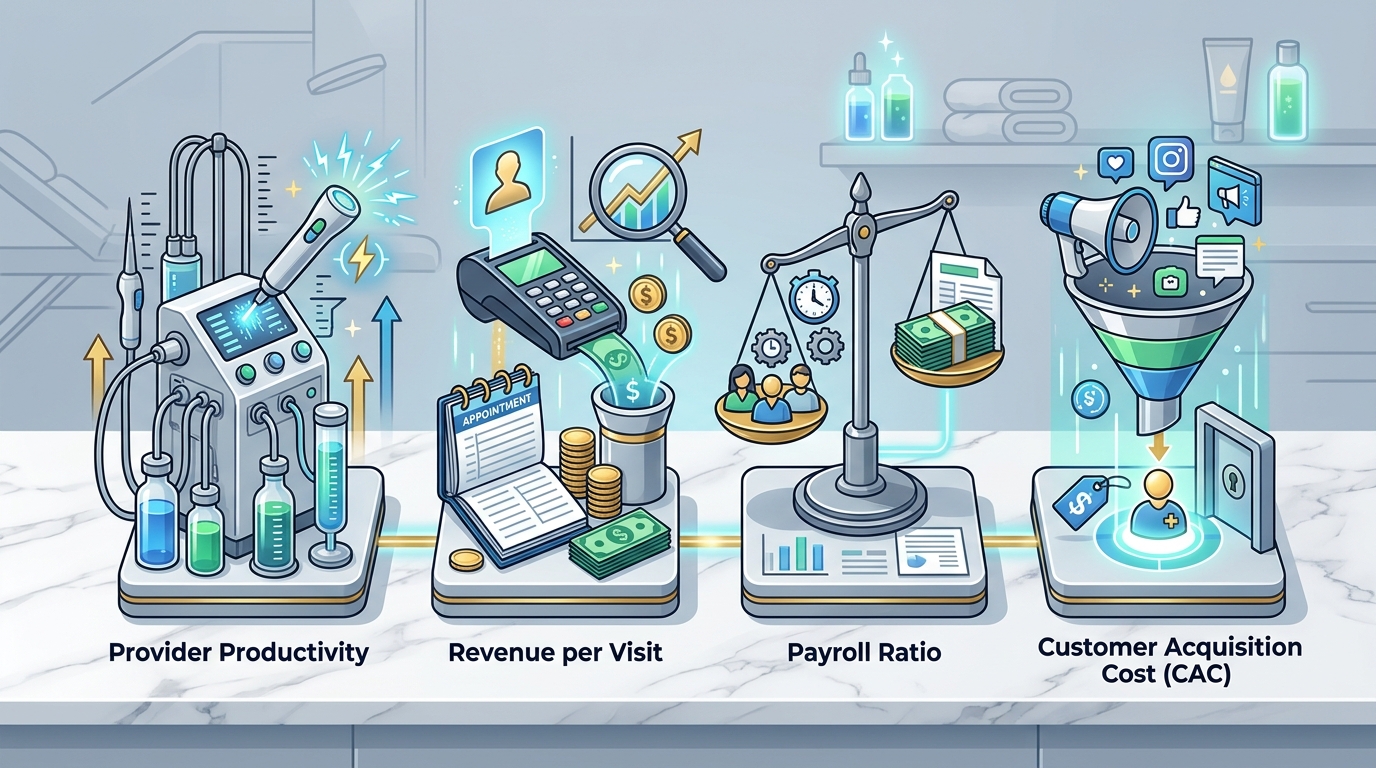
Med spa owners should track provider productivity, revenue per visit, payroll ratio, and customer acquisition cost to gauge financial health. These four metrics reveal where money is made, lost, or trapped in operations. This guide explains how to calculate each metric and why it matters for sustainable growth. Relentless CFO helps med spa owners turn these numbers into strategic clarity.
Provider Productivity Metrics
Provider productivity is the measure of how much revenue or profit a specific clinician or aesthetician generates relative to their time and compensation. In a med spa, providers are your primary revenue engine. Tracking this metric ensures you are not overpaying for low output or underutilizing high performers. It is the foundation of labor efficiency in aesthetic practices.
Calculating Productivity
To calculate provider productivity, divide the total revenue generated by a provider by their total compensation (salary plus commissions). A common benchmark is a ratio between 3:1 and 4:1. This means for every dollar you pay a provider, they should generate three to four dollars in revenue. If the ratio drops below 3:1, you are likely losing money on that provider's labor costs after accounting for supplies and overhead.
Why It Matters
High-performing providers drive the majority of your profit. Identifying them allows you to incentivize retention and growth. Conversely, low-performing providers may require additional training, schedule adjustments, or reassignment. Relentless CFO advises owners to review these ratios monthly to catch trends before they impact quarterly profits.
Revenue Per Visit
Revenue per visit is the average amount of money a customer spends during a single appointment. This metric is critical because it reflects the effectiveness of your pricing strategy, upselling capabilities, and service mix. It is a direct indicator of how well your front-of-house team and providers are maximizing each client interaction.
Improving the Metric
To increase revenue per visit, focus on package deals, add-on services, and product sales. For example, pairing a Botox treatment with a facial or selling at-home skincare products can significantly boost the average ticket size. Track this metric by service type to identify which treatments have the highest potential for upselling. A rising revenue per visit often signals strong brand loyalty and effective marketing.
Benchmarking
There is no single universal benchmark for revenue per visit, as it varies by location and service menu. However, tracking the trend over time is more important than comparing to competitors. If your revenue per visit is stagnant while your cost of goods sold increases, your margins are shrinking. Use this data to adjust pricing or promote higher-margin services.
Payroll Ratio
Payroll ratio is the percentage of your total revenue that goes toward employee wages, benefits, and taxes. It is one of the most significant expense categories in any service-based business. In the med spa industry, a healthy payroll ratio typically falls between 30% and 40% of gross revenue. Exceeding this range can erode your net profit, even if revenue is growing.
Managing the Ratio
To manage your payroll ratio, align staffing levels with demand. Overstaffing during slow periods inflates this ratio, while understaffing during peak times can lead to lost revenue and poor customer experience. Consider using part-time or per-diem staff to maintain flexibility. Additionally, review commission structures to ensure they align with profitability goals, not just revenue targets.
Impact on Cash Flow
Payroll is a fixed or semi-fixed cost that must be paid regardless of cash flow fluctuations. High payroll ratios can strain cash reserves during seasonal dips. Relentless CFO helps owners forecast cash flow needs based on payroll obligations, ensuring you always have enough liquidity to cover expenses.
Customer Acquisition Cost
Customer acquisition cost (CAC) is the total cost of acquiring a new customer, including marketing, advertising, and sales expenses. It is a vital metric for understanding the efficiency of your marketing spend. In the med spa industry, CAC can vary widely depending on the channels used, such as social media, email marketing, or local advertising. according to Sustainability advertising Wikipedia
Calculating CAC
Optimizing Acquisition
Track CAC by channel to identify which marketing efforts deliver the best return. If one channel has a high CAC but low retention, it may not be worth the investment. Focus on channels that attract high-value, loyal customers. Relentless CFO recommends reviewing CAC quarterly to adjust marketing budgets and maximize ROI.
Comparison of Key Metrics
| Metric | Definition | Typical Benchmark | Primary Impact |
|---|---|---|---|
| Provider Productivity | Revenue generated per provider relative to compensation | 3:1 to 4:1 ratio | Labor efficiency and profit margins |
| Revenue Per Visit | Average spend per customer appointment | Varies by location and menu | Pricing strategy and upselling effectiveness |
| Payroll Ratio | Percentage of revenue spent on payroll | 30% to 40% | Cash flow stability and operational cost |
| Customer Acquisition Cost | Total cost to acquire one new customer | Depends on LTV (LTV > 3x CAC) | Marketing efficiency and growth sustainability according to Sustainability advertising Wikipedia |
Key Takeaways
- Provider productivity should be tracked monthly to ensure labor costs align with revenue generation.
- Aim for a provider productivity ratio of at least 3:1 to maintain healthy margins.
- Revenue per visit reflects the success of your pricing and upselling strategies.
- Keep your payroll ratio between 30% and 40% of gross revenue to protect cash flow.
- Customer acquisition cost must be lower than one-third of your customer lifetime value.
- Track these metrics by location and service type to identify specific areas for improvement.
- Use data to make informed decisions about staffing, pricing, and marketing budgets. according to Maternal medication drug
- Regular financial reviews with a fractional CFO can help you interpret these metrics effectively.
Frequently Asked Questions
What is a good provider productivity ratio for a med spa?
A good provider productivity ratio is typically between 3:1 and 4:1. This means for every dollar paid in compensation, the provider generates three to four dollars in revenue. Ratios below 3:1 may indicate labor inefficiency.
How do I calculate revenue per visit?
Divide your total revenue for a specific period by the number of customer visits during that same period. This gives you the average amount spent per appointment. Track this by service type for deeper insights.
What is the ideal payroll ratio for a med spa?
The ideal payroll ratio is generally between 30% and 40% of gross revenue. This range allows for healthy profit margins while covering labor costs. Ratios above 40% may indicate overstaffing or low revenue per employee.
How can I reduce my customer acquisition cost?
Reduce CAC by focusing on high-retention marketing channels, improving referral programs, and optimizing your website for conversions. Track CAC by channel to identify and invest in the most efficient sources.
How often should I review these financial metrics?
Review these metrics monthly to catch trends early. Quarterly reviews are useful for strategic planning and budget adjustments. Monthly tracking ensures you can make timely operational changes.
Why is customer lifetime value important alongside CAC?
Customer lifetime value (LTV) represents the total revenue a customer generates over their relationship with your business. Comparing LTV to CAC helps determine if your acquisition costs are sustainable. A healthy business has an LTV that is at least three times its CAC.
Conclusion
Tracking provider productivity, revenue per visit, payroll ratio, and customer acquisition cost is essential for med spa owners who want to understand their true financial health. These metrics provide a clear picture of where money is made and lost, enabling data-driven decisions that drive sustainable growth. Relentless CFO offers fractional CFO services designed to help med spa owners turn financial complexity into clarity. To plan your next step, for a strategy call.