

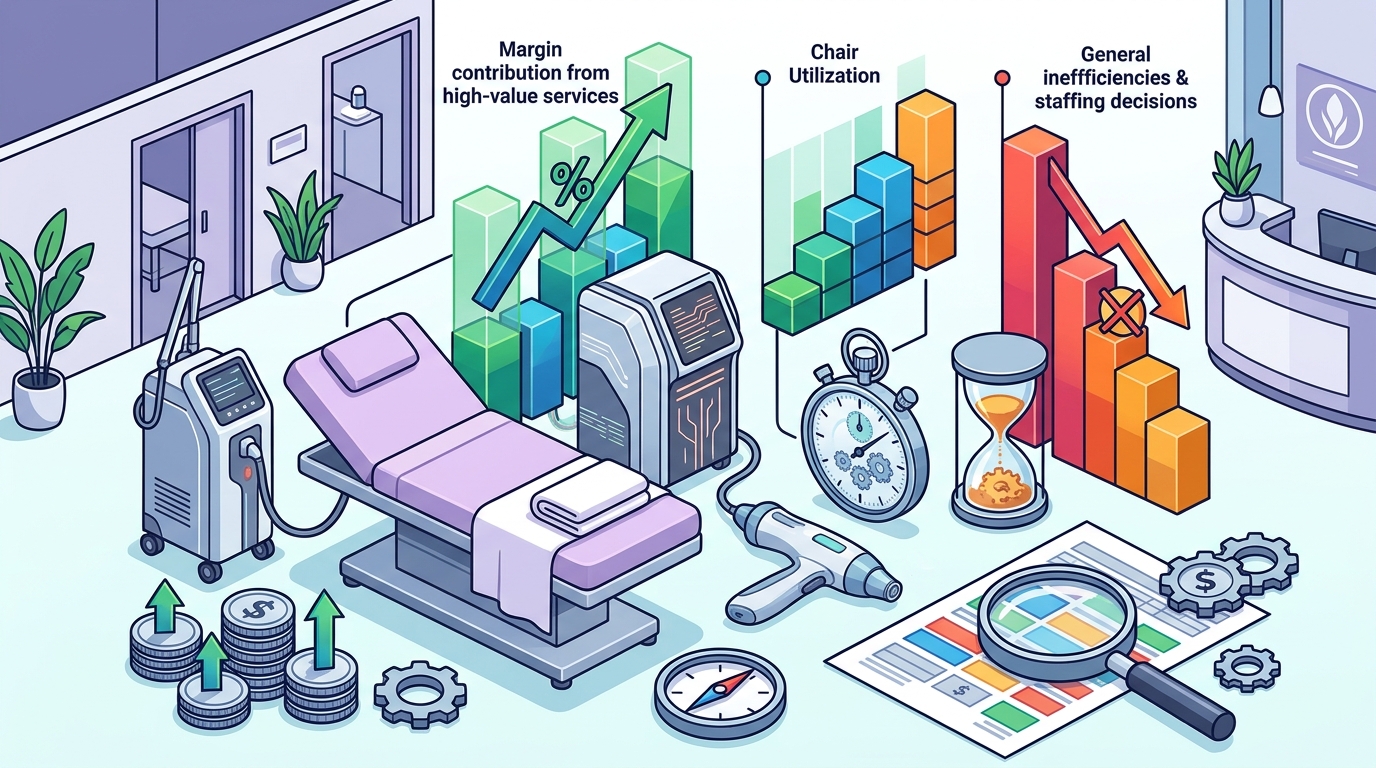
Med spa owners can monitor staff productivity by tracking provider-specific revenue, chair utilization, and margin contribution rather than just total hours worked. Relentless CFO helps owners shift from vague performance assumptions to data-driven insights that directly impact the bottom line. By analyzing which providers generate the strongest margins and how efficiently they use expensive equipment, owners can identify underperforming assets and optimize compensation structures. This approach ensures that high revenue does not mask low profitability caused by inefficient staffing or poor pricing decisions.
Why Revenue Alone Misleads Med Spa Owners
Revenue is the total income generated from sales, but it does not account for the costs required to generate that income. In a multi-million-dollar med spa, a provider might generate high revenue but consume excessive overhead, product costs, or chair time, resulting in a low net margin. Relentless CFO emphasizes that a multi-million-dollar med spa can be highly profitable or have significant amounts of money disappearing into poor margins and operational inefficiencies. The problem is not necessarily that the business is unsuccessful, but that growth makes it harder to see what is actually happening at the individual provider level.
When owners rely solely on gross revenue, they may reward providers who sell high-volume, low-margin services while ignoring those who drive true profitability. For example, a provider who performs many low-cost facials may appear busy but contribute less to the bottom line than a provider who performs fewer, high-margin laser treatments. Understanding this distinction is critical for making informed decisions about staffing, compensation, and service menu pricing.
Core Productivity Metrics to Track
Provider productivity is the measure of how effectively a staff member converts their time and resources into profitable revenue. To monitor this, owners should track three core metrics: revenue per provider, margin per provider, and chair utilization rate. These metrics provide a clearer view of who is generating the strongest financial returns and where operational bottlenecks exist.
Revenue and Margin per Provider
Tracking revenue per provider is essential, but tracking margin per provider is more critical for profitability. Margin per provider is the net profit generated by a specific staff member after deducting their direct costs, such as product usage and commission. A provider with a high margin per hour is more valuable to the business than one with high revenue but low margin. This metric helps owners identify which providers are driving the most value and which may need retraining or reassignment.
Chair Utilization and Equipment Return
Chair utilization is the percentage of available treatment time that is actually used for billable services. Expensive devices, such as laser machines or cryotherapy pods, represent significant capital investments. If a high-cost device is underutilized, it drags down the overall return on investment. Owners should monitor whether expensive devices are producing an acceptable return relative to their cost. This data helps determine if a device is generating enough revenue to justify its presence or if it is becoming a financial burden.
Aligning Compensation with Profitability
Compensation structures in med spas often rely on simple revenue-based commissions, which can misalign provider incentives with business goals. To improve the bottom line, owners should consider compensation models that reward margin contribution rather than just gross sales. This approach encourages providers to focus on high-margin services and efficient use of resources. Relentless CFO advises that a clearer financial story should help owners answer which providers generate their strongest margins. By aligning pay with profitability, owners can motivate staff to make decisions that benefit the entire business. according to Running the Numbers
For instance, a provider who upsells a high-margin add-on service should be rewarded more than one who sells a low-margin package. This shift in compensation philosophy can lead to better overall profitability without necessarily increasing total revenue. It also helps owners identify providers who are not only productive but also profitable, allowing for more strategic staffing decisions.
Identifying Operational Inefficiencies
Owners should also look at the relationship between staff size and revenue. If the team is growing faster than revenue, it may indicate that the business is not scaling efficiently. Relentless CFO notes that as the business grows, it simply becomes harder to see what is actually happening. By tracking productivity metrics, owners can ensure that each new hire contributes to profitability rather than just adding to overhead. This data-driven approach allows for more confident decisions about hiring, firing, or restructuring the team.
Making Data-Driven Decisions
Data-driven decisions are choices based on analyzed financial and operational data rather than intuition. For med spa owners, this means using productivity metrics to guide strategic moves such as expanding services, opening new locations, or adjusting pricing. A useful assessment should give owners something back before it asks for anything. Relentless CFO offers a Financial Clarity Scorecard that helps owners assess their visibility across profitability, cash, operations, financial control, and growth readiness. This tool provides a baseline for understanding where the business stands and what needs improvement.
By regularly reviewing productivity data, owners can make proactive adjustments rather than reactive fixes. For example, if a specific provider is consistently underperforming, the owner can intervene with coaching or reassignment before the issue impacts the bottom line. This proactive approach saves time and money, allowing the business to focus on growth and customer satisfaction. It also builds a culture of accountability and continuous improvement within the team.
Key Takeaways
- Revenue alone does not reflect profitability; track margin per provider to identify true value drivers.
- Chair utilization and equipment return are critical for justifying capital investments in expensive devices.
- Align compensation with margin contribution to incentivize providers to focus on high-profit services.
- Monitor operational inefficiencies such as no-shows and gaps in scheduling to free up billable capacity.
- Use data-driven decisions to guide hiring, pricing, and expansion strategies for sustainable growth.
- Regularly review productivity metrics to ensure that team growth aligns with revenue and profitability.
Frequently Asked Questions
What is the most important metric for med spa provider productivity?
Margin per provider is the most important metric because it reflects the net profit generated by each staff member after deducting direct costs. This metric provides a clearer view of who is driving the strongest financial returns and helps owners make informed decisions about compensation and staffing.
How often should med spa owners review productivity data?
Owners should review productivity data monthly to identify trends and make timely adjustments. Regular reviews allow for proactive management of performance issues and ensure that the business remains aligned with its financial goals.
Can high revenue providers be unprofitable?
Yes, high revenue providers can be unprofitable if they consume excessive overhead, product costs, or chair time. This is why tracking margin per provider is essential for understanding true profitability.
How does equipment utilization affect the bottom line?
Equipment utilization affects the bottom line by determining the return on investment for expensive devices. Underutilized equipment can become a financial burden, while high utilization can drive significant profitability.
What role does compensation play in staff productivity?
Compensation plays a significant role in staff productivity by influencing provider behavior. Aligning compensation with margin contribution encourages providers to focus on high-profit services and efficient use of resources.
How can owners identify operational inefficiencies?
Owners can identify operational inefficiencies by monitoring metrics such as no-show rates, gaps in scheduling, and chair utilization. These metrics highlight where time and resources are being wasted and provide opportunities for improvement.
Conclusion
Monitoring staff productivity is essential for med spa owners who want to improve their bottom line. By tracking metrics such as margin per provider, chair utilization, and equipment return, owners can make data-driven decisions that drive profitability. Relentless CFO helps successful med spa owners turn financial complexity into financial clarity, providing the tools and expertise needed to achieve better decisions. To plan your next step, to discuss how you can optimize your med spa's financial performance.