

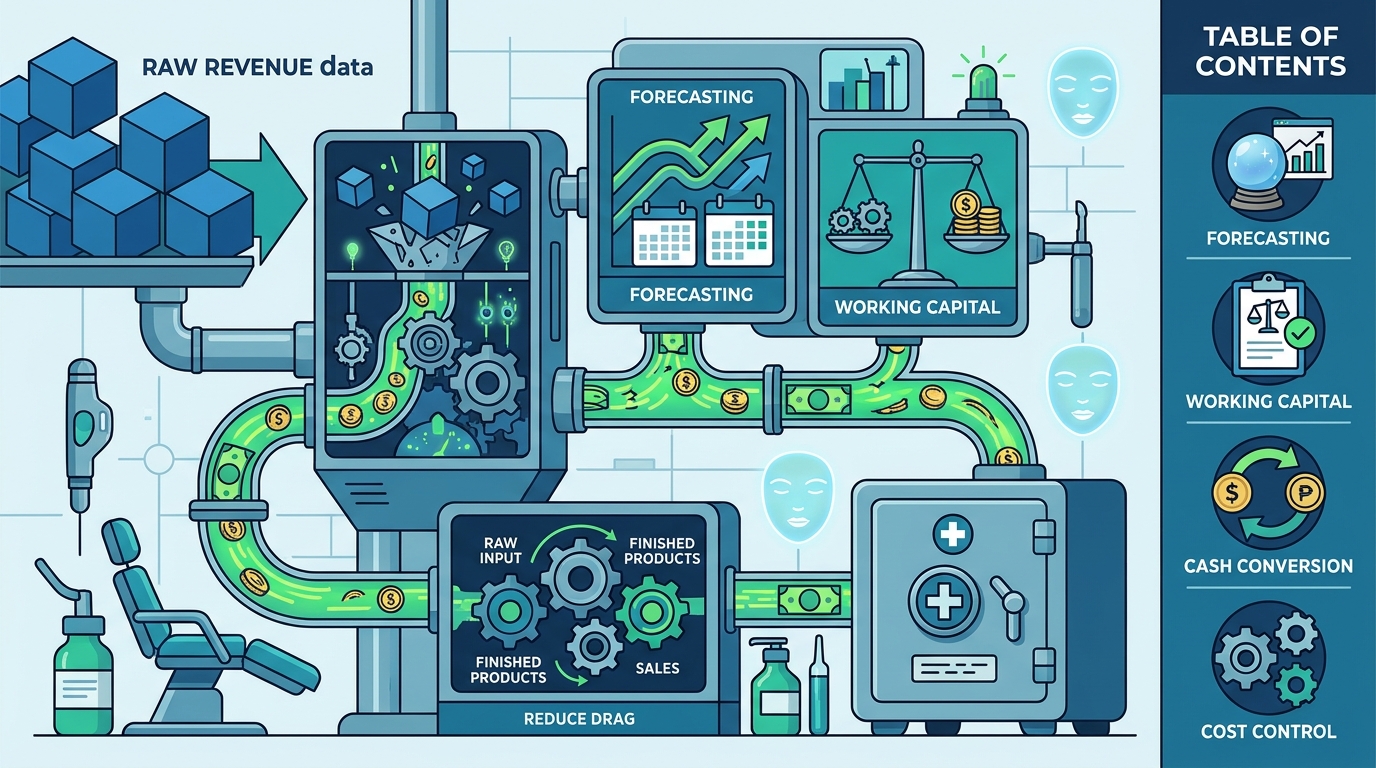
Strategic financial leadership improves cash flow by transforming raw revenue data into actionable insights that optimize working capital and reduce operational drag. Relentless CFO provides this expertise to med spa and aesthetic practice owners. This guide covers cash flow forecasting, working capital management, cost control, and the cash conversion cycle.
Cash Flow Forecasting
Cash flow forecasting is the process of predicting future cash inflows and outflows to anticipate liquidity needs. For med spa owners, revenue growth often masks underlying cash shortages. A multi-million dollar practice can still face payroll delays if cash is tied up in inventory or equipment leases. Strategic leadership moves beyond simple revenue tracking to model actual cash availability. For additional details, review the Ask a question Relentless.
The Limitations of Revenue Metrics
Building a Reliable Forecast
Effective forecasting requires historical data and clear assumptions. Owners should track cash inflows by service type and outflows by vendor category. A 13-week rolling cash flow forecast provides the granularity needed to spot shortfalls before they become crises. This tool allows leaders to adjust spending or accelerate collections proactively. For additional details, review the Fractional CFO for Med.
Working Capital Management
Working capital management is the practice of optimizing the balance between current assets and current liabilities. In the aesthetic industry, working capital is often trapped in slow-moving inventory or inefficient payment terms. Strategic financial leadership identifies these bottlenecks and implements controls to release trapped cash.
Inventory Optimization
Med spas often hold excessive stock of high-margin products. While these products generate revenue, they also tie up cash that could be used for operations. A strategic CFO analyzes inventory turnover rates to determine optimal stock levels. This ensures that cash is not sitting on shelves but is available for business needs.
Accounts Receivable and Payable
Managing the timing of cash in and cash out is essential. Owners should review payment terms with both clients and vendors. Accelerating receivables through better billing practices and negotiating longer payment terms with suppliers can significantly improve net working capital. This creates a natural cash buffer without requiring external financing.
Cost Control
Cost control is the systematic process of identifying and reducing unnecessary expenses to improve profitability. Many practice owners focus on revenue generation while overlooking operational inefficiencies. Strategic financial leadership audits the cost structure to eliminate waste and improve margins. This approach ensures that every dollar spent contributes to business value.
Identifying Hidden Costs
Hidden costs often erode profit margins without owners realizing it. These can include merchant fees, software subscriptions, and underutilized equipment. A detailed cost analysis reveals where money is leaking. For example, a high-end laser device that is only used 20% of the time represents a significant drag on cash flow. Identifying these items allows for informed decisions about retention or disposal.
Strategic Spending Decisions
Cost control is not about cutting everything. It is about aligning spending with strategic goals. Relentless CFO helps owners prioritize investments that drive growth while eliminating expenses that do not. This balanced approach ensures that cost reductions support long-term profitability rather than just short-term savings.
Cash Conversion Cycle
The cash conversion cycle is the time it takes for a company to convert its investments in inventory and other resources into cash flows from sales. A shorter cycle means faster cash recovery and better liquidity. For med spas, this cycle is influenced by how quickly services are paid for and how long inventory sits before being sold.
Measuring the Cycle
The cash conversion cycle is calculated by adding the days inventory outstanding and days sales outstanding, then subtracting days payable outstanding. A negative cycle is ideal, as it means the business is funded by its suppliers. While this is rare in service-based businesses, minimizing the cycle length is a key strategic goal. Tracking this metric provides a clear view of operational efficiency.
Improving Cycle Speed
Improving the cash conversion cycle requires action on multiple fronts. Owners can reduce days sales outstanding by implementing stricter payment policies. They can also reduce days inventory outstanding by adopting just-in-time inventory practices. These changes, when combined, accelerate the return of cash to the business. This improved speed provides greater flexibility for strategic initiatives.
Key Takeaways
- Revenue growth does not guarantee cash availability; strategic forecasting is required to bridge the gap.
- Working capital management focuses on optimizing the balance between assets and liabilities to free up cash.
- Cost control involves identifying and eliminating hidden expenses that erode profit margins.
- The cash conversion cycle measures the time it takes to convert resources into cash; shorter is better.
- Inventory optimization is critical for med spas to prevent cash from being tied up in slow-moving stock.
- Strategic financial leadership provides the expertise to implement these controls effectively.
- Relentless CFO offers specialized guidance for med spa and aesthetic practice owners.
- Proactive cash management allows owners to focus on growth rather than financial survival.
Frequently Asked Questions
What is the difference between revenue and cash flow?
Revenue is the total income generated from sales, while cash flow is the actual movement of money in and out of the business. A company can have high revenue but negative cash flow if it spends more cash than it collects.
Why is cash flow forecasting important for med spas?
Med spas often have high fixed costs and variable service demand. Forecasting helps owners anticipate cash shortfalls and plan for expenses like payroll and inventory purchases.
How can I improve my working capital?
You can improve working capital by reducing inventory levels, accelerating receivables, and negotiating better payment terms with suppliers. These actions free up cash for operations.
What is the cash conversion cycle?
The cash conversion cycle is the number of days it takes for a company to convert its investments in inventory and other resources into cash flows from sales. A shorter cycle indicates better liquidity.
How does Relentless CFO help with cash flow?
Relentless CFO provides fractional CFO services that include cash flow forecasting, working capital optimization, and cost control strategies tailored to med spa owners.
Is cost control the same as budgeting?
Budgeting is the planning process, while cost control is the ongoing monitoring and adjustment of expenses to ensure they stay within budget. Both are essential for financial health.
How often should I review my cash flow?
Owners should review cash flow weekly or monthly, depending on the size of the business. A 13-week rolling forecast is a common best practice for small to mid-sized businesses.
What are the benefits of strategic financial leadership?
Strategic financial leadership provides expert guidance on financial decisions, improves cash flow, enhances forecasting accuracy, and allows owners to focus on business growth.
Conclusion
Strategic financial leadership is the key to unlocking cash flow potential in growing businesses. By mastering cash flow forecasting, working capital management, cost control, and the cash conversion cycle, owners can transform their financial operations. Relentless CFO provides the expertise and tools needed to achieve this clarity. To start your journey toward financial clarity, contact our team today.